


The Barbell Method:
Marketing The Extremes
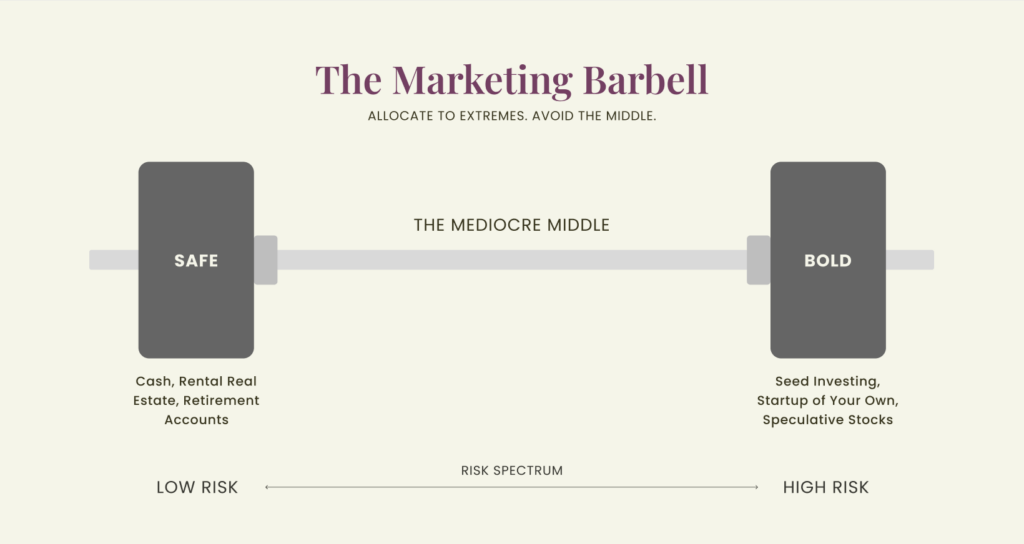
The barbell strategy for investing comes from Nassim Taleb’s book, Black Swan. Though impossible to summarize in one sentence, I’ll give it a try. Essentially, you’re allocating money in two ends of the risk spectrum: low risk (Cash, Rental Real Estate, retirement accounts) and high risk (seed investing, startup of your own, speculative stocks).
We do this at Pintler Group to make our portfolio sturdy. Survive economic downturns while leaving the door open to an extremely high upside, and avoiding the middle entirely.
Okay. Three(ish) sentences.
I’m an entrepreneur, not a financial advisor. I’ll talk a little bit about my investment strategies, but the goal is to talk about how the barbell method can be applied to your marketing.
I’ve run a fair amount of marketing campaigns for companies of all shapes and sizes. Likely thousands of campaigns from retailers in downtown Missoula to onboarding Fortune 500 organizations with our software.
So this article is about the barbell strategy, and how I believe that if you use this concept in marketing, it can result in outsized returns. Insert marketing acronym here: ROI, ROAS, CPL, CAC. GEESH.
Below: example of a barbell investment strategy.
My Theory of the Case:
Companies rolling out the barbell marketing strategy as part of their playbook will enjoy outsized returns on their investment of time, money, and energy. And will separate themselves from the mediocre middle.
Nobody Ever Got Fired Marketing in the Middle.
Marketing in the middle (taking moderate risk investing in “proven” channels) doesn’t get you fired, but it will land you in the middle. Middle management. Middle of the road. Mediocracy.
Imagine you’re in a leadership position tasked with growing the company. Or maybe you’re the executive director of a non-profit.
I would think about allocating an annual marketing budget between the safe and the risky. All while avoiding the middle. The marketing barbell.
Barbell Summary:
Safe Marketing Activities. The “Blocking and Tackling” of Your Marketing Budget:
In investing (again, not financial advice), Taleb makes the case for allocating capital to extremely safe investments so you can weather an unforeseen black swan event: a sharp economic downturn, natural disaster, a global pandemic, or shifting macroeconomic trends.
While at the same time, having a small but focused amount of money in high-risk investments. Most may fail, but if one succeeds, there’s a tremendous upside.
Here’s how the concept can apply to your marketing.
Left Side: Blocking and Tackling
Low-frequency waves. Day after day. Month after month. Slowly compounding.
Lower Funnel Activation: Abandoned Cart Emails.
Retention Marketing: The marketing stuff that equals repeat customers.
Strong organic presence across platforms: LinkedIn, Instagram, Facebook, Reddit (being sure not to put all your eggs in one basket).
Social Monitoring: How is your brand talked about online? Defending the moat.
Tracking net promoter scores: exceeding expectations for and delighting current customers.
Again: very little (if any) risk is involved with the above. The high-interest savings account of a marketing company.
Right Side: Low Down-side, High Up-side
Now, let’s skip the middle for now and up the risk level. It’s time to gamble.
Of course, not all speculative investments return 100x BUT, but marketers can benefit from thinking like venture capitalists who need to return a 100x fund, the VC needs a very small number of extremely successful “winners”, like one or two, depending on deal size and fund.
Highly Speculative: High Risk. High Reward:
This is where you log out of the 100k/yr attribution software. This isn’t about blended customer-acquisition-cost, seven-day-view-through-rates, or reducing the CPM on the streaming TV for the Houston market. This is about hockey stick-type results.
Let’s run through some ideas:
Unconventional PR: Doesn’t have to be jumping out of space, but it is a classic example.
Guinness World Record.
You’re a surfboard upstart (actual employee project!) You’re not going to outspend the Goliaths. You’re not going to out-impress at Outdoor Retailer. So you’ve gotta think differently. How about setting a Guinness World Record for the longest river wave session in history? This might make for some fun headlines. And the downside if it doesn’t work? You’ve got to ride a river wave for a bunch of hours.
Total Loss: 5 Hours? Maybe 25 hours? What is that current record anyway?
Creating a YouTube Series.
Again, log out of the attribution software. This one is gonna be tough to measure the immediate impact. But it’s a right-side-of-the-barbell tactic. It’s difficult to move the boulder (record the first video), but once done, the object is in motion. Here’s an example of zero-to-one with our software RevelForms. And your competition is too distracted with attribution software to grab a camera themselves.
Potential upside? A story worth telling. A captivating founder journey that builds trust, buy-in, and buy-ers.
The potential downside: you have a video series of ten videos with a combined view count of 83. On to the next idea.
Total. Loss: 10k.
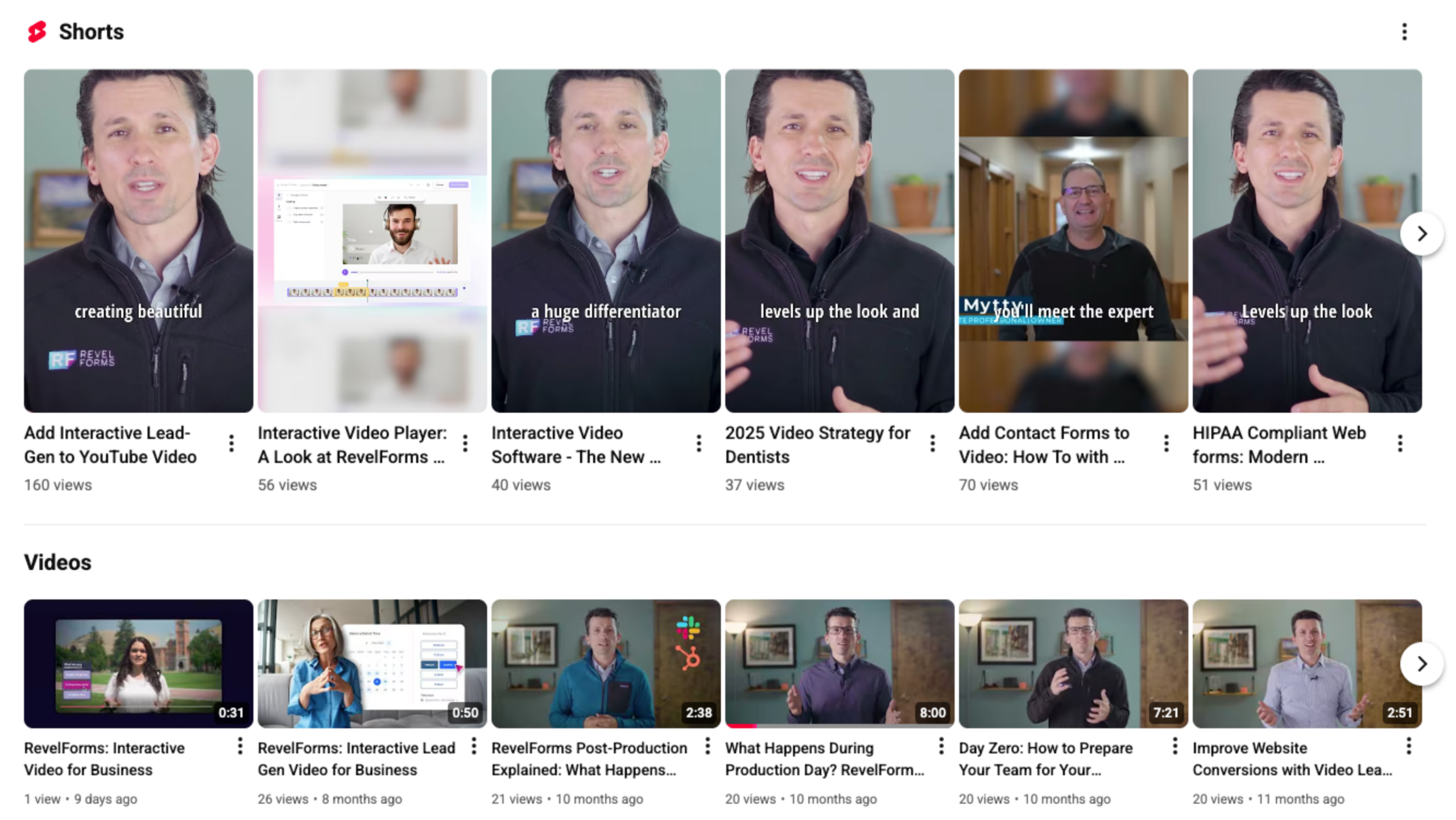 *Example of RevelForms YouTube page*
In-Person Events: Large and Small
Host a small event. Pay for it all. Buy the dinner. Add real value to attendees in the form of a quick deck. Hand it out and pay for colored printing.
Upside: You’ve added a ton of value to a small but mighty curated group. You’ve surrounded yourself with people smarter than you.
Downside: You picked up the check and never hear from them again.
Total Loss: 1k-20k.
Time / Resource Allocation?
10% of marketing energy/time/resources toward low-probability-of-success but high-impact tactics.
 *Shown above is our very own Ana attending Spryng by Wynter conference in Texas*
Avoid the Middle. Okay. But What’s in the Middle?
“Media Buys”
$250k into an ad campaign with too-good-to-be-true key performance indicators and an account specialist “placing media.”
Audience Expansion. The SQUIRREL! effect.
You haven’t reached 100% of your target audience. Pretend you’re a university that is known for its veterinary science program. People from all over the country apply to it. They seek it out. And you have enrollees from 46 states.
There’s the capacity to grow it to the largest in the country. The tendency at this moment is to direct your gaze to the business school program. This is the wrong tendency. This is the tendency of the middle.
Brand Awareness:
No matter how awesome it is to report 1.7 million impressions. Unless you’re Jurassic Park 9, you don’t actually want to spend money here. There are so many places to spend marketing dollars today with way higher intent. Brand awareness campaigns are squarely in the middle of the barbell.
Top of Mind:
See Brand Awareness.
Chasing Vanity Metrics:
We see this quite a bit and call it out when we do. A blog post from 2019 contributes 30% of total traffic. The problem is, the blog post has nothing to do with the core product or service. New visitors to the site flock to the article. If bouncing from the page without taking any further action was a conversion, that traffic converts 100% of the time.

Things You (or I) Don’t Understand
“Omnichannel Bidtream Intelligence Engine”
“Incrementality-Calibrated Media Mix Modeling.”
“Supply Path Optimization Suite”
If it feels like a foreign language: hang up. Close out. If you’re wondering, the translation is we keep 80% of the marketing dollars you give us. But our reports and conference rooms are going to be glossy AF. Other translations include the middle.
There you have it.
Thanks again to Taleb and his books: Black Swan, Antifragile, Skin in the Game. His arguments inspired this method. Though he argues his approach from an investment standpoint, I believe it also applies to marketing and growing your business. It allows for a more antifragile strategy: one that not only withstands shocks and uncertainties but also thrives on them.