Bootstrapping a software product means you embody resourcefulness. Every dollar you spend on a conference ticket, online ad, print material, or flight to visit a client had better be well thought out. There’s pressure to show a return on investment because, without it (in the early days), the money runs out. You need customers. But you don’t have the money to acquire customers. But your customers are what’s funding your business.
Funding a company through happy customers is right up there on the hardest things I’ve ever done list. BUT, as a pioneer in the Montana software entrepreneurial community (Michael Fitzgerald) once told me: “If you can get to ten customers, the world is yours. He was right.
I might add an asterisk: Get to ten customers WITH product market fit. How do I define product market fit? The hand-wavvy way is if your customers would be upset if you went away. If you disappeared, would your customers miss you? Would they even notice? If the answer is no, you have work to do, and you’re not ready to talk about, take action toward, or listen to podcasts about scaling. Your sole focus is on talking to existing customers.
If You Want to Bootstrap:
Bootstrapping means keeping things lean. Like everything. This is not a nice-to-have. It’s a must-have. Keeping your life lean of expenses. Monthly recurring or otherwise. When I started GeoFli, my wife and I:
Lived in the downstairs studio apartment of a house we (barely) bought and rented the upstairs 3 bedroom (which paid the mortgage).
I do this a lot. For example, I traveled to Minneapolis to visit a customer paying $200/month. We met for 45 minutes. DeckDirect. They were personalizing content for folks within driving distance of their showroom (stop in!) vs. visitors outside driving distance (check shipping rates!) I talked with their marketing director, and she mentioned a couple of features she’d love to see: reporting, scheduling, and more geo-regions. We made it happen, and it created a customer for life.
Drove one car: paid off Subaru Forester with 100k+ miles.
Savings and one year of runway to take the edge off.
My wife worked as a teacher, and we were still able to save.
We’ve kept lifestyle creep at bay. But with the growth of the business, we’ve indulged in things like heated seats in the car
(sold the Subaru for $600 in 2018). Moved upstairs, and we now book direct flights. No more saving $17, but adding a layover in Albuquerque.
Keeping your business lean of expenses:
What this looks like:
Shared logins for tools like Zapier (sorry Zapier) and others.
Packing the small-but-mighty team into a co-working space in the early days.
Exchanging conference tickets for taking pictures of the event.
Bootstrapping looks slightly different today than it did in 2015. There’s more noise, but it’s just as easy to stand out from the noise as it ever was. Just hike a quarter mile.
The air is clear(er) after your first ten customers with product market fit. All of a sudden, there’s recurring revenue showing up in Stripe. The graph doesn’t look broken. This is an insanely exciting time, and insanely difficult to get to. Knowing that you were resourceful. You earned. It.
If you’ve never been to Yellowstone National Park, there’s something the brochures don’t tell you about. Bison Jams. Traffic caused by bison. Usually, it’s visitors slowing down to take pictures or attempting to feed carrots to the roadside wild animals. Other times, the bison are literally on the road, stopped or slowly meandering to their next destination using the paved path of least resistance.
There’s something that happens when you’re visiting a national park. It’s natural to human nature. You’re driving through, and you notice a group of two, maybe three cars pulled over. The visitors are out of their car, peering into the distance. Some with binoculars. Some with telescopic camera lenses. Okay, you’ve got me. I’m slowing down, rolling down my window, and asking: “Whatchya spottin’?”
“A wolf is teaching its cubs to hunt.”
Okay. Pull over next to that no parking sign and let’s have a look.
You look through binoculars. And for three minutes, you witness the miracle of nature. Wolf cubs clumsily getting their footing. Pouncing. Stalking. Learning.
At the five-minute mark, you pull back from the binoculars and remember that you’re standing on a narrow shoulder of pavement. You also notice you’re no longer the only one illegally parked. There are 27 other cars and 7 RVs doing the same thing you are. Doors slamming. Engines running. All of a sudden, it’s crowded.
This is what happens when you stay roadside. Three minutes of quiet followed by the overwhelming of floodgates.
It takes no time at all. Something cool is happening. You’re early to the party. And in a matter of minutes, the party is overcrowded.
The solution? Hike a quarter mile. That’s once around the track.
A “blue ocean strategy” is about finding places or opportunities that aren’t crowded or competitive.
For example, my wife and I love traveling during the shoulder seasons. Living in Montana, we’re used to seeing places that are usually packed feel empty. Think Glacier in April or Yellowstone in November. It might be colder, but you get the experience almost entirely to yourself.
This weekend was another great example. We found a beach on the Maine coast about 30 minutes from where we were staying. After doing a little digging on Google Earth and reading a few blog posts, we found a trailhead. It was a short walk, about half a mile with a little elevation, and there were only three cars in the parking lot.
Within minutes, we reached the beach at low tide. It was incredible, with a wide open shoreline, small rocky islands, sand dunes, and miles of untouched coast, with barely anyone else around.
The point is simple: instead of going where everyone else goes, look for the less obvious option. That’s where you often find the best experiences
Cue abrupt transition to the business metaphor.
You can easily identify the platforms that are crowded. The equivalent of the sides of the road with 34 vehicles parked, snapping pictures, and scaring away the wolf cubs. I used to book high-quality demos with personalized LinkedIn messages. Those days are gone. Crowded. So I started groups, took over as admin to existing groups, and curated small but valuable conversations. That’s the .25-mile hike. I used to write articles about simple but less talked-about tactics on Google Search and the early days of Instagram ads. Publish. Then get traffic. That slowed as the market became saturated with repeat information. I hiked .25 miles and started writing instead about very specific tactics. Underutilized tacts in overutilized channels. Those gained steam, sent visitors, and led to online leads for our Montana software companies. (RevelForms and GeoFli)
Other examples of the quarter-mile hike: doing what a large percentage of the competition is unwilling, unmotivated, and too unorganized to do:
Write and contribute to your profession. Put things down on paper. Hit publish.
Record. Record video. Create a library. Send specific videos to specific verticals. Here’s an example with dentists. Here’s an example with higher ed. Both of these have booked high-quality demos.
Under-utilized tactics. Straight from Gaberiel Weinberg’s Traction. If you find yourself in a crowded platform, you’ll need to use underutilized tactics to stand out. Warning: these too become the equivalent of the wolf cub on the side of the road, but if you capture the opportunity, they can be lucrative. See Meta Lead Ads. (see a real-life example below)
In-person sales pitches. Okay, might need to go farther than .25 miles. But maybe not! Either way, in person > Zoom, and most people take the easy way out here.
Talk to customers. We’ve gotten so used to AI chatbots, talking to your customers is a true differentiator.
Have you hiked a proverbial quarter mile and found solitude, blue oceans, and opportunities? Drop them here, albeit at the risk of opening the flood gates 🙂
Here are my five key takeaways from my first five weeks in my digital marketing internship.
Starting a new internship can be both exciting and overwhelming, but my first month at the Pintler Group has been a really positive learning experience. From picking up new skills to getting a behind-the-scenes look at digital marketing: specifically performance marketing, I’ve already learned things that I know will be useful throughout my career. Here are five key skills I am working on.
1: Have a Solid Foundation of Research Before You Dive In
One of the first skills I’ve focused on is building a strong research foundation before starting any project. At Pintler Group, I’ve had access to several helpful tools like Answer the Public, Google Keyword Planner, Google Trends, and Reddit Pro. These tools have been helpful because they provide insight into what audiences are actively searching for, talking about, and engaging with online. Using them allows me to identify common questions, trending topics, and relevant keywords when building Google Paid Search campaigns, which helps ensure campaigns are based on real data rather than assumptions. Early in my internship, we worked on a mock campaign for Bloom Nutrition, where we spent a lot of time studying what people were searching for and what was trending in the market. It was interesting to see topics like supplements and health trends come up repeatedly and to understand how that information could shape marketing strategies. This showed me how important research is before jumping into creative work.
2: Content Creation with Strategy in Mind
Another skill I’ve been developing is creating content with a strategy behind it. At Pintler Group, we talk a lot about continuity and how important it is in marketing. Continuity means keeping a consistent brand message, look, and tone across platforms. When a brand looks and sounds the same everywhere, it becomes easier for people to recognize and trust it. I’ve learned how to apply this idea while also using each company’s brand pillars and core values, making sure every post, caption, and landing page stays aligned with the brand’s message. This has helped me understand that good content isn’t just creative, it also has to fit into a bigger plan.
Check out this friggin’ awesome Figma board Lily and I helped build as part of our content Tuesday initiatives. It’s everything you could want to know about continuity conversion optimization and it took us a ton of time. It will take you about five minutes to get through.
3: Be Confident in Your Ideas
Building confidence in your ideas can be really intimidating, especially as an intern when professionals in the field surround you. It can feel nerve-racking to speak up or share ideas when you’re not sure if they are “good enough.” However, I’ve learned that showing initiative and being willing to share new ideas is better than staying silent. One example of this is Content Tuesdays at Pintler Group, where we set aside time to focus on promoting our own business instead of just our clients. This semester, my fellow intern Lily and I have been responsible for creating internal content for Pintler Group’s social media. Each week, we brainstorm and pitch ideas that show off Pintler Group as a brand. While presenting ideas to experienced professionals can be nerve-wracking, the feedback has been really encouraging, and the process has helped us learn new tools and ways to improve our content.
4: Organization + Communication is Key
Staying organized has been a much bigger priority than I expected. Taking time to properly label files, organize bookmarked tabs, and keep track of tasks makes everything run more smoothly and saves a lot of time in the long run. In the marketing world, having a clean and easy-to-navigate computer system is important because projects move fast and information needs to be easy to find. A cluttered workspace can make you seem unprepared or disorganized, even if you are doing good work. Organization can be the difference between a campaign launching on time or missing a crucial deadline.
A bonus key learning in my digital marketing internship:
I’ve also learned that strong organization supports clear communication. Keeping people updated, maintaining a paper trail of conversations, and asking questions early all rely on having information that is easy to access and track. When organization and communication work together, it prevents confusion later and allows teams to move faster with confidence. Being organized and communicating clearly helps The Pintler Group work more efficiently and keeps projects on track.
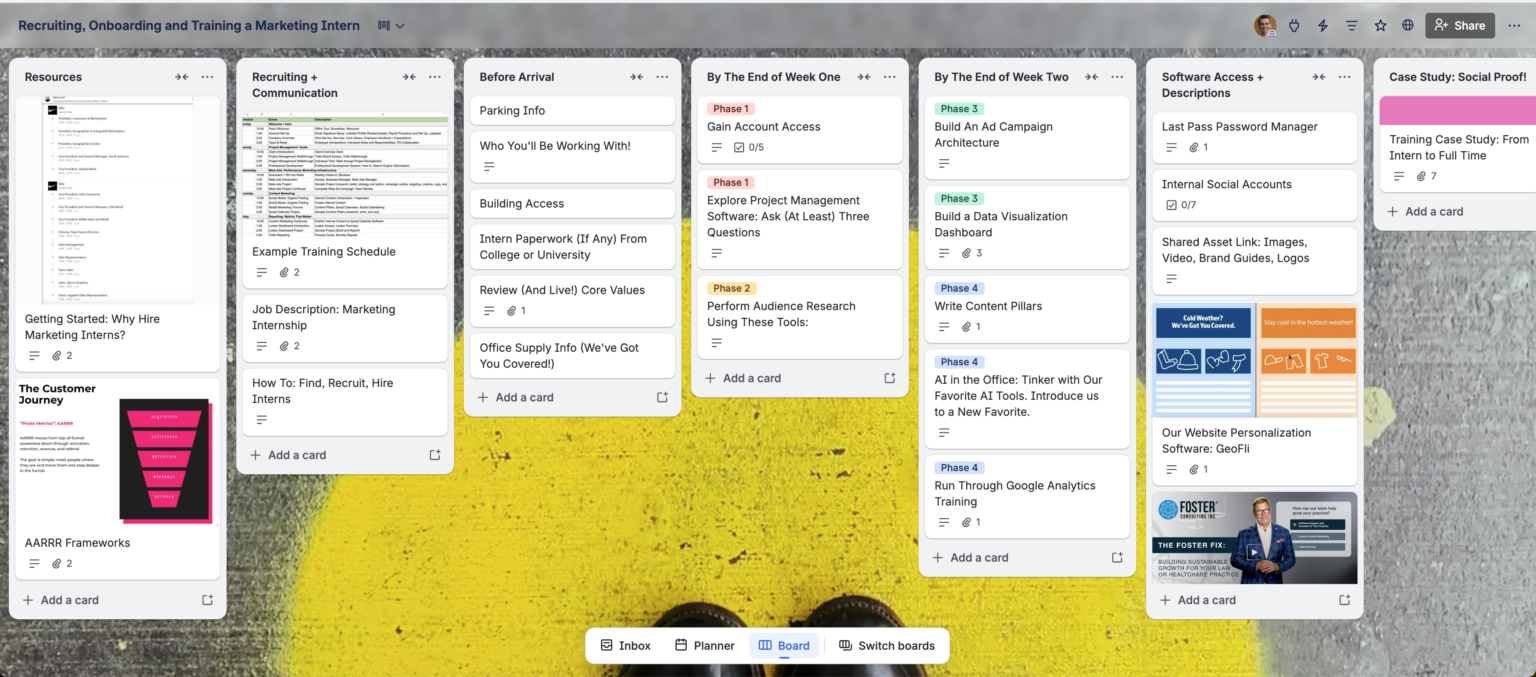
Below: Click on the image to check out (a template of) my training board in Trello.
5: Ask for Feedback + Grow From It
Another important skill I’ve learned is how to ask for feedback and actually use it to get better. At first, it can feel uncomfortable to hear what needs to be changed, especially when you’ve put a lot of time and effort into something. But I’ve learned that feedback is meant to help you grow and succeed, not take away from your work. When I get suggestions or edits, I try to see them as chances to improve instead of as mistakes. Getting feedback also helps things stick in your mind for next time. Over time, this has helped me feel more confident and better at adjusting my work to meet expectations.
I know there are so many more small skills I will continue to learn during my internship at The Pintler Group, but I hope these are skills you can also take and apply to your own internship or even just your everyday workspace.
Below: One of our weekly professional developments in January was a summary from book club: “Radical Candor” by Kim Scott. Check out the deck below.
Yes. Starting at the very beginning here. Might think it goes without saying, but we’ve seen 10,000 person email lists sit dormant for years.
Email them what you said you were going to email them when they signed up. Delight them with exclusive content, previews and behind the scenes of the operation.
2. Lookalike Audience:
Meta, Reddit, Spotify, YouTube, Google Search, TikTok, Snapchat, Connected TV (MNTN, VIBE etc): they all make it possible to jump in, add your credit card, upload your email list and they do the hard work of matching your email subscribers with lookalike (demographics, psychographics, buying intent and more).
3. Retargeting List:
Retargeting in the digital marketing landscape is certainly not new. But it’s gotten lazy.
With email, your customers have already raised their hand. Add your emails to (see list of platforms directly above). The platforms take your existing emails and match them to users. Now the 10,000 email subscribers you have are also seeing messages about events, programs and videos from your brand. If you’re looking to advertise efficiently, this is the purest center of the bullseye you can get. For bonus points: segment your retargeting lists. Show ads to the students interested in health sciences different from those that have landed on specific pages of your website related to the Forestry program.
4. Tag + Sort: Find the Top 10%
You can likely do this manually by just looking at lifetime earnings. There are tools you can pay money to that also support this (Enrich Labs being One). This is such an important piece of the email puzzle because as we’ve mentioned, not all emails are created equal.
5. See If You Have Any Celebrities / Influencers In The Mix:
You have thousands of emails. There’s a high likelihood someone’s purchased from you, walked through your door (brick and mortar) or is just a fan. Using a tool like influencers.club you can upload your list and they’ll match against a database of influencers (340M profiles) to see if any of your subscribers have a few million Instagram followers. Send ‘em a kickback. This is certainly a more affordable option than trying to partner with them! SparkToro from Rand Fishkin is a solid too to help provide some clarity here.
6. Survey Them: Ask Your Customers What They Want
You’ve got a (somewhat) captive audience. Have questions about your product? A conference room dispute to settle? Umm … has anyone thought to ask the customer?! Survey the customers or just manually email the top 3% of spenders or power users.
7. Surprise The Power Users:
Non profit: your highest donors.
E-Commerce: Your highest revenue customers.
B2B: Your longest tenured subscribers and customers.
Higher Ed: The ones that would register for classes in 2028 if given the chance!
Send them something meaningful. Something fun. Something of value. But anything that shows you value them. Make their brand affinity to you stronger than ever.
8. Traffic On Demand:
Leverage your email list to launch a blog. Start a YouTube series or podcast and Instantly get listens. This is the power an email list delivers. You instantly have a built in megaphone for your next project.
9. Test Language and Offers:
With enough emails, you can AB test different offers to see which one has the higher response rate. For example, want to test out tiered pricing and your audiences receptiveness: send one email to 50% of your list and another to the other 50%: which one had more purchases?
10. Personalize:
Personalize the list based on location (for higher ed this would be sending different emails to out of staters than in-staters). Personalize based on interest (whattup tags and personalizing websites based on location!)
11. Tag Users as they Enter The List:
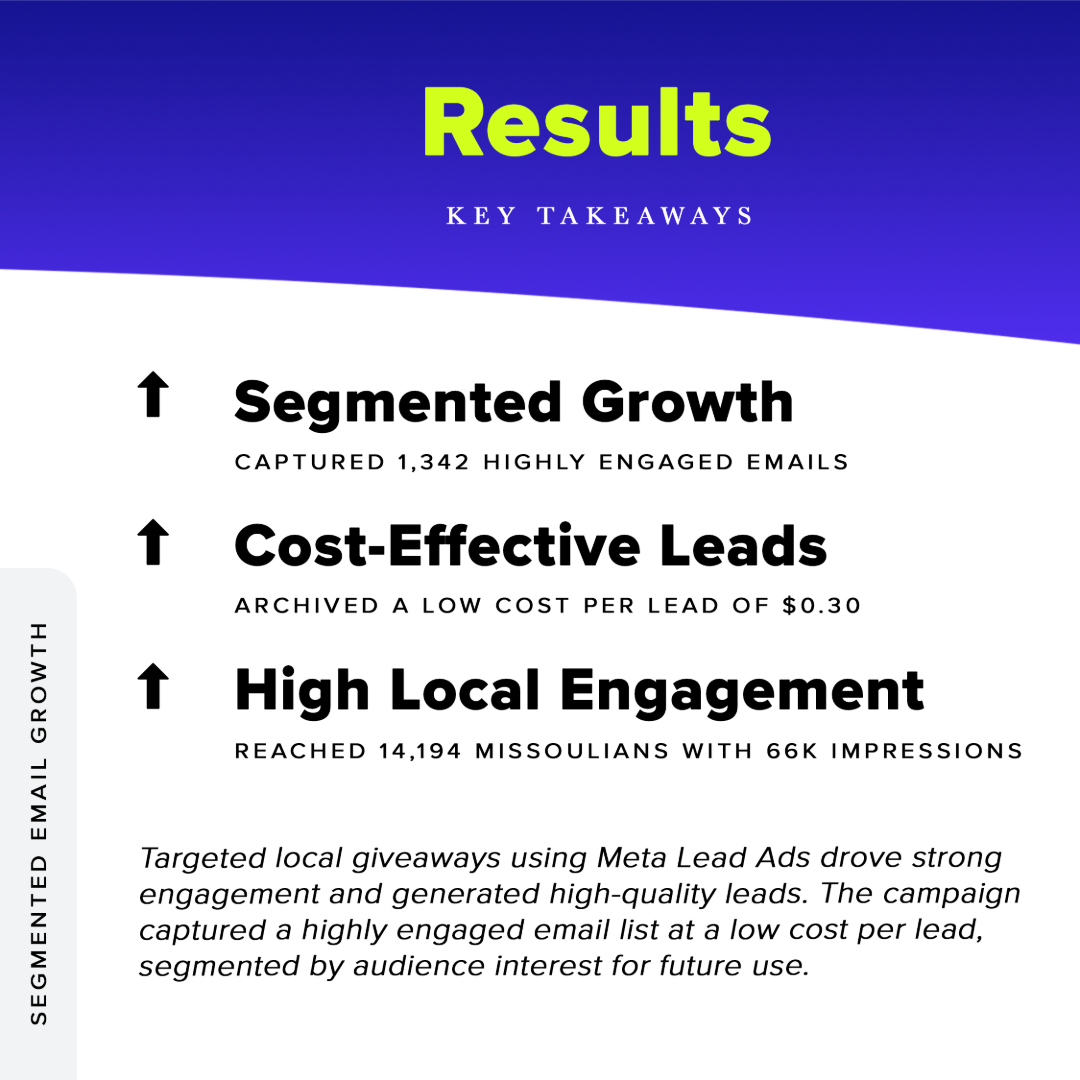
This is a big on … and often overlooked. When we run Meta lead ads, we tag users based on their interest category. If we’re targeting healthcare with our ads, any lead through that ad-set is tagged as healthcare. Same applies to higher ed marketing and small business.
12. Simple “Reply to This Email” Language:
Sure, it’s tempting to hire a design team and build a beautiful email marketing template. But resist the urge. Plain text email can outperform highly designed, and just feel more human in a world where AI generated email templates can be, well, AI generated. At the end of the email, simply say “reply here, I respond to every email!” and you’ll be surprised how many replies you get.
13. Having Options is a Superpower: You Could Just Wait (While Your List Grows)
One thing you can do with your email is just let it cook. I know, if you made it this far and aren’t excited about leveraging the power of this incredible marketing asset, I’m not sure how good of a persuader we are: but having a robust email list that sits dormant is a billion times better than not having one at all. Transparently, there have been long stretches in Pintler Group’s tenure where our own email goes unused. But it is always growing. Having the option to turn the faucet on is extremely helpful.
Below: we made this video in 2022: and it’s still highly relevant today. Another example of how durable email marketing truly is.
14. Set up Automations (Responsibly)
We’ve seen the flood gates open on HubSpot workflows, Mailchimp sequences, Salesforce comm-flows and whatever else CRM + email marketing software is calling sending email time released. This could and should be a separate article entirely, but for now, we’ll say this is a great strategy to keep your users engaged and reminded of your brand, so long as the content you’re sending is of value.
15. Get Users To Your Website:
Sure, a 4-5% click rate is considered good. Which sounds bad. BUT, compare that to tiny percentages of click-through-rates for display ads, programmatic ads (like .01% CTR) it’s pretty good. Our team recently has been putting together sample reporting templates, and including them (free of charge) to share with our email list. Click rates have been reaching double digits easily.
There you have it. We’ve included our custom Executive Marketing dashboard below and made it incredibly simple to duplicate and add your own data sources! Try it out below.
Rule Number One: Tell people why they’re giving you their email. I’m not opting in (and I’m sure you’re not either) to an email list if I’m not sure it’s valuable to me, if I’m not sure the frequency, and if I’m not sure the purpose.
Rule Number Two: Don’t use email scrapers. There’s spam in your inbox. And then there’s human spam. Don’t be both. Growing email lists require real effort.
Rule Number Three: keep the contact form simple. If you truly need first name and phone number, ask for it. But have a really compelling reason on ask for it. Otherwise, start with top of the funnel (email) and put in the hard work to gather more info.
Tools > Content > Generic Offers. For example.
Gated Mortgage Calculator > Buying a House Guide > Sign up for Our Newsletter.
Great, you’re a believer in the lasting power and value of acquiring, nurturing and building an email list: so how the heck do you get started?
Here are some ways: organized by 100 level, 200 level and 300 level degrees of difficulty.
100 Level Email Marketing Growth
Collect Emails at Live (free) Events:
Point of Sale: The email list building strategy equivalent to opting in to your company’s 401k match: the no-est of no brainers. Square, Toast, Strip: whatever it is: make sure your customer emails are getting stored somewhere you have access. Our Montana based digital marketing firm, Pintler Group, is gleefully shocked when we hear a new client has thousands of emails from their point of sale but hasn’t ever sent an email. This is the lowest of low hanging fruit.
Collect Emails at Live (ticketed) Events:
People took time out of their busy lives to attend your free event. Maybe it’s because there’s pizza, or maybe it’s because they’re down with our cause. Whatever the reason: manually walk around and collect emails. In our experience, these are the emails with the highest open rates, click-rates, sales: everything.
Yes, you’ll have the emails from your ticketing software, but not all. Someone buys five tickets, you have one email. During the event, run a quick give-away or have a place for folks to add their email (maybe through an i-pad). These folks paid money (Venmoed their friend whose email you have) to attend. If you deliver on a great experience, they’ll attend the next one too.
Ask Contacts:
Having great conversations with folks in your network, in your vertical, in your line of work? Let them know you’ve got an email list you’re curating, it’s a monthly send including company updates, things we’re learning and ways to get involved. Sure, this is manual and doesn’t scale across website visitors: BUT, these are likely going to be connectors in your industry, and perhaps not all email addresses are created equal!
Generate Leads In Video:
Using video lead gen software, you can actually generate a lead directly in the video by asking for email. In addition, you can ask multiple choice questions, open ended questions and even show different video based on the viewer’s answer. Here’s a look at how video lead-gen software works. It’s easy (hence why it’s in the 100 level breakdown!)
Don’t use “Sign up for our Newsletter.”
This worked in 2015. It does not work today. Users need more. Clear value proposition as to why they should sign up. I don’t need another newsletter and neither do you or your website visitors. I do need a reporting template, a free consult or a demo of how the product can help grow my business.
200 Level Course (Slightly More Resources + Expertise to Execute)
Run a Contest:
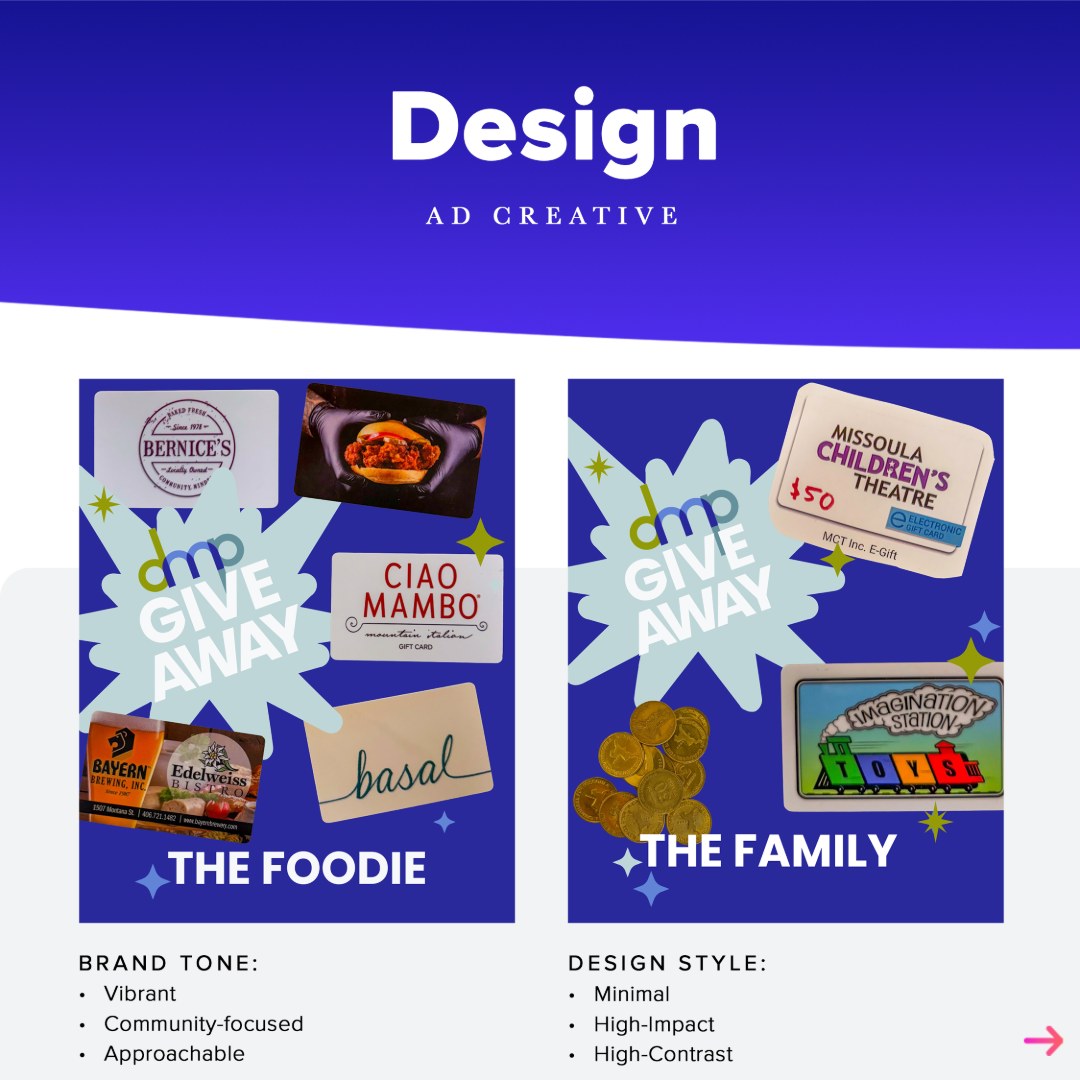
But not just any contest. For example, something we did recently was give away “date-night” packages including dinner + movie gift cards. We photographed the bundle, used the photos in Meta targeting (in a relationship, geographically located within a 20 mile radius of Missoula, foodies). Users entered through Meta (more on that soon) and we linked the contest submission directly to Mailchimp tagged “relationship” for future date-night events, restaurant announcements and more.
Facebook Lead Ads:
Related to running contests (since it’s the mechanism for doing so in a large-scale way). FB Lead Ads have been kind of a roller coaster ride of impactfulness over the years, but recently we’ve noticed positive results (and by positive, we mean for every five emails there’s one qualified). Without going too much into the weeds of the set-up, this involves building an ad account in Meta. These ads appear on newsfeeds (IG + FB) mobile and desktop. When you click “learn more” or “sign up” it opens a lead-gen form.
Use “Email Us” as a CTA (And make sure to Reply!)
We could talk at length about the decaying conversion rates of simple form fields on websites, but one thing we’ve also noticed is companies and brands hiding behind “contact us” forms at prime decision points in the custom journey. On your website, make it really easy to email a question. And most importantly: be sure to actually reply. User clicks “contact” and it opens their email browser. You can even decide what the first couple lines of the email can be!
Give-To-Get:
An oldie but a goodie. Modified for the year we’re living in: this used to be white-papers (email to get a PDF). Now it can be any number of awesome bounties. Some of our favorite include interactive Figma Boards like this one showcasing the “top 50 college website” and “75 Campus Visit Pages”
Make Something (not a PDF) Your Audience Wants. Give it to them for (their email) free!
I’ll throw the dart at the wall. It lands on “Private Soccer Coaching Industry.” Great! You run a private soccer coaching business. Put together a three part video course designed for 6-8 year olds. Almost as a primer to your more in depth private coaching. They meet you, they see your coaching and training style, and you get their email to hopefully continue to provide value and one day earn a client. Let’s Goooooal!
Exit Intent (Used in an Elegant Way)
This one can be controversial for the general public, and for the evergreen-ness of this article. Personally, it’s not a favorite, but decided to put it on the list because after running tests and talking with my conversion rate optimization (CRO) savvy friends, this tactic works.
On-Page Chat (Prompt for Email)
Of course, our top recommendation would be to staff the chat with a real person: someone that can chime in and respond to questions and route users to the right place. When that person is away, we recommend keeping the chat up. AI chats are powerful, and can be coached to make sure and collect email of the person asking the questions. We do this on our software sites and while we don’t get flooded with chat notifications, we do increase our email list by a few each and every month. Month after month after month.
Pop Up (At the Right Time … With the Right Message)
Whether it’s scroll depth or our personal favorite, showing a personalized message on the right page at the right time (like a “campus visit” page on a higher ed website) we’re bullish on pop-ups done well. You can also time trigger the pop ups to send after a user has been on the site for a certain amount of time (say 10+ seconds).
300 Level: Next Level Email Growth Tactics
Engineering As Marketing:
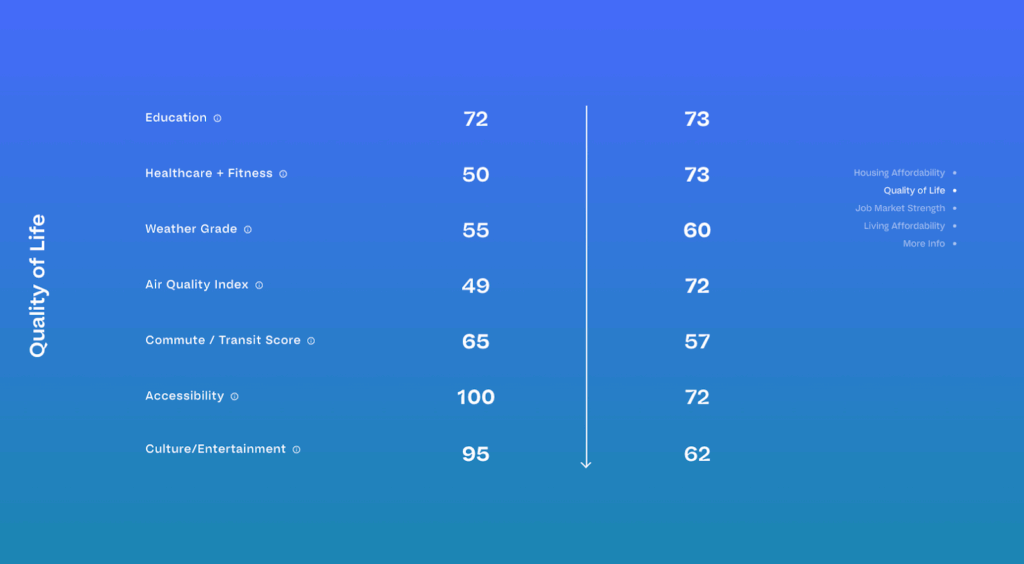
What the heck is this? Think mortgage calculators or any type of quiz that delivers a value to the end user … in exchange for their email. One of our personal favorites is Coldwell Bank “Move Meter.
Here, users enter two zip codes, and the “Move-meter” delivers custom curated scores based on key consideration factors like education, weather, culture and transportation. You can talk to an agent (corresponding and geotargeted by zip code of course).
Host a Webinar:
Hey! We practice what we preach. We hosted two webinars in the last three months and grew our email list. Most importantly, we met with about 20 prospective interns through the University of Montana (who we partnered with on the webinar) and introduced them to the world of digital marketing agency work.
Personalize Your Email Newsletter Based on Location:
Using geopersonalization software like GeoFli, you can have the “ask” on your website personalized: something along the lines of: “Colorado’s favorite email newsletter!” or “Find shows within a 50 mile radius of Boston!” These subtle changes to headers and calls-to-action can mean percentage point jumps in email sign-up conversion. Try it out here.
Product Led Growth:
We’re just getting to rock all the hits today! Product led growth, another one of our favorites makes it possible for users, if they’re in your app or engaging with your product do recommend to a friend or add users in a highly simple way. Using your product to lead growth: product led. Hotmail may not be the timeless example here, but early on when they were the kings of email, they used a simple “
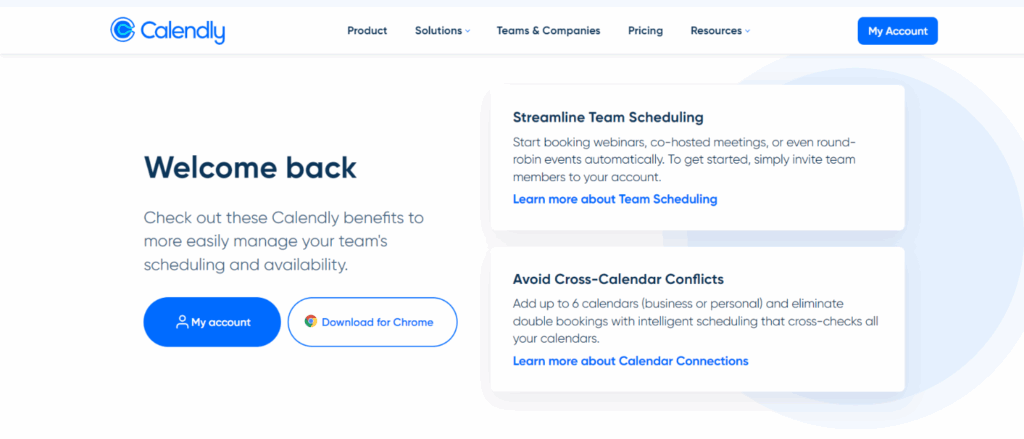
Below: Calendly when you log-in promotes some of their enterprise features.
If you liked this article: check out our Figma board with other resources, design inspiration and a link to our executive marketing dashboard.
In this article, the Pintler Group Digital Marketing team argues for building a foundation or anchoring your marketing strategy around email lists. The marketing asset that keeps on giving.